
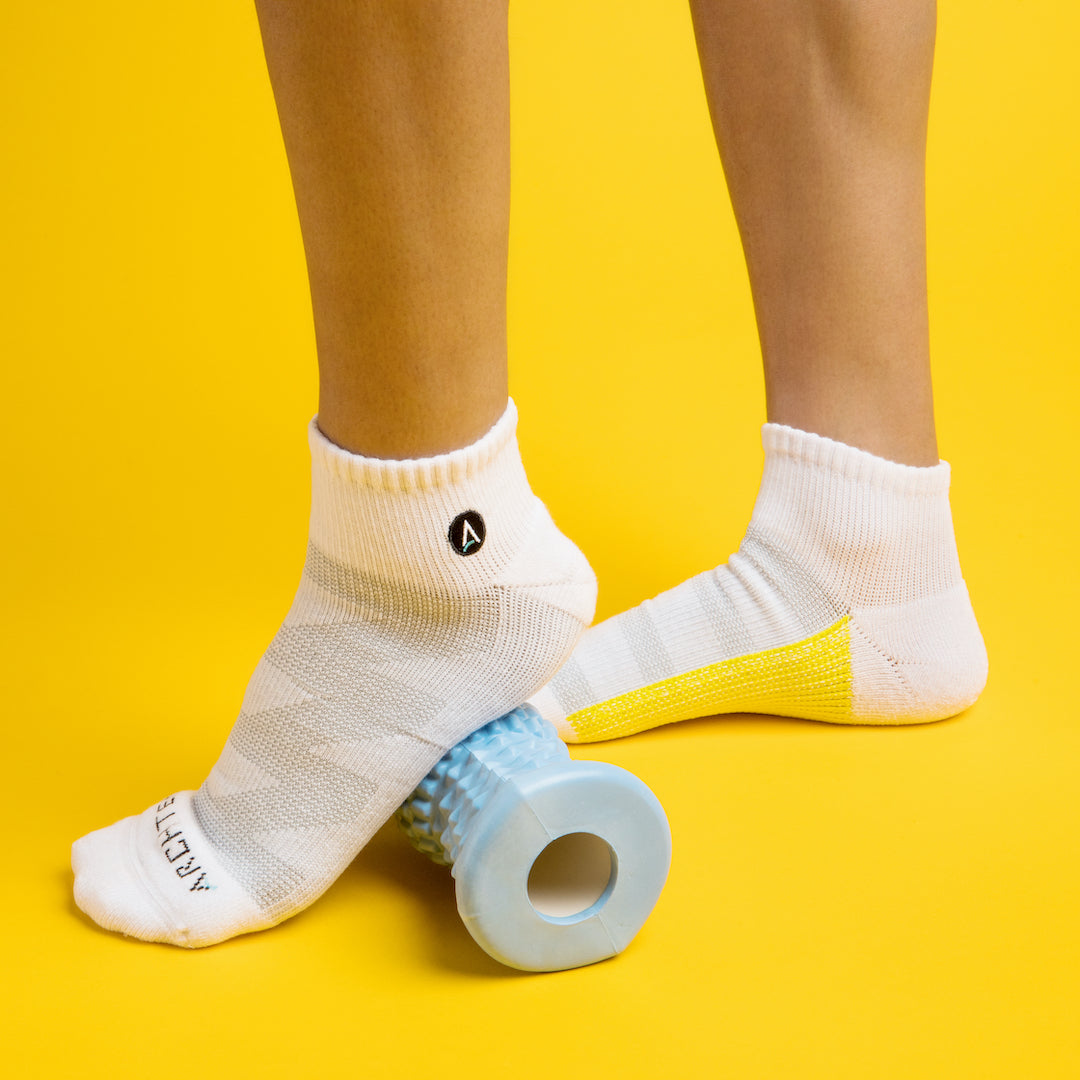
Article: Top-Rated Socks for Nurses Who Are on Their Feet All Day
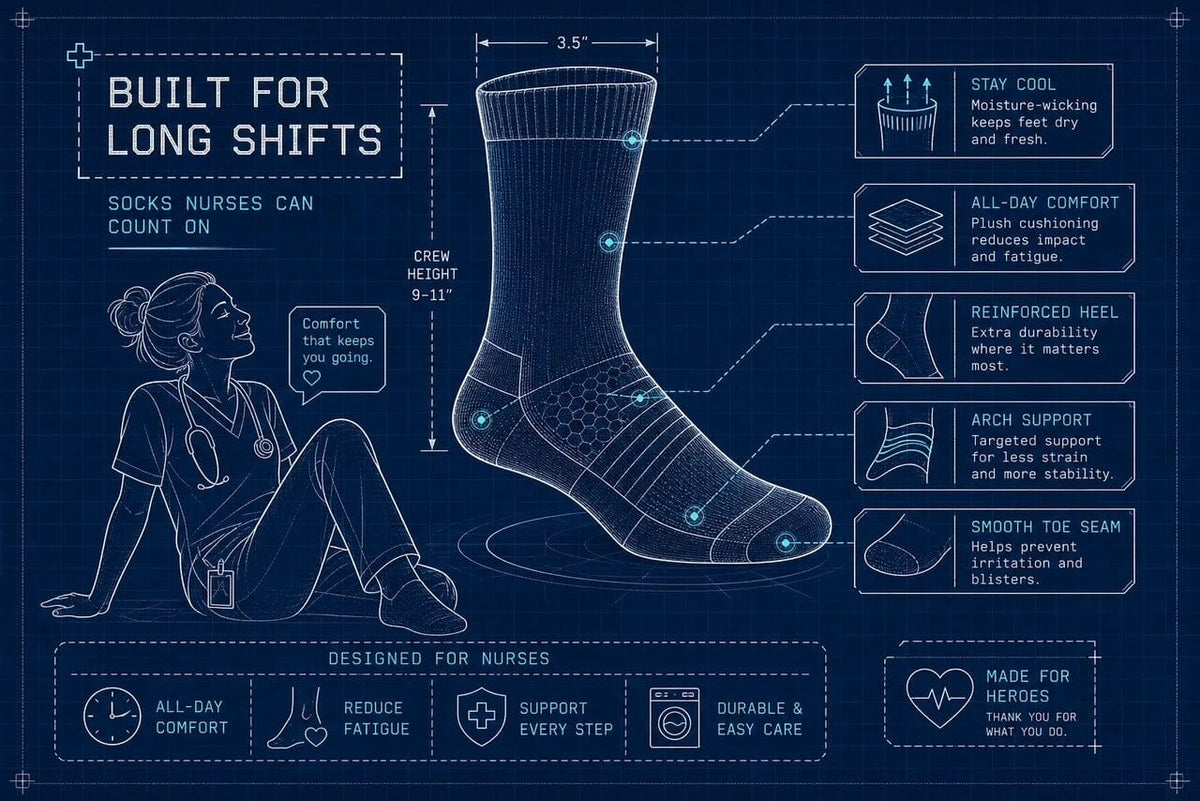
Top-Rated Socks for Nurses Who Are on Their Feet All Day

By hour seven of a twelve-hour shift, many nurses already know. The ache starts in the calves, the arches flatten under the accumulated weight of miles of hallway walking, and the ankles begin to hold fluid that wasn't there at the start of the shift.
This isn't wear-and-tear in the dramatic sense. It's physics: sustained pressure on the venous system and plantar fascia, repeated across every shift, every week, for a career.
The right socks for nurses can address each of those mechanisms directly, and that distinction matters more than most healthcare workers realize until the damage is already accumulating.
The default response for most healthcare workers is a multi-pack from the drugstore. That approach leaves a significant amount of functional support on the table. The right pair of nursing socks doesn't just cover your feet; it actively manages circulation, absorbs impact, and may help reduce the cumulative load associated with plantar fasciitis, chronic swelling, and venous issues that often develop early in a nursing career.
Research supports compression socks for reducing venous pooling, leg fatigue, and end-of-shift swelling. Evidence for preventing plantar fasciitis onset is more limited, which is why structural arch support matters alongside compression.
Archtek Socks was founded by Dr. Bob Baravarian, a foot and ankle surgeon with over two decades of clinical practice treating the conditions nurses develop over their careers: plantar fasciitis, arch strain, venous swelling, and calf fatigue.
That clinical background shaped every design decision in the brand.
This guide covers the features that actually matter for shift work, how to match compression level to your specific symptoms, and the best socks for nurses available in 2026.
What Actually Separates Socks for Nurses From Regular Socks
The gap between a standard athletic sock and a sock built for healthcare work comes down to five structural features.
Understanding them makes the difference between buying based on price and buying based on function.
Graduated Compression and What It Does for Your Legs
Graduated compression is the most important feature in any compression socks for nurses doing shift work.
It works by applying the highest pressure at the ankle and decreasing that pressure progressively up the calf. This gradient narrows the leg veins, increases blood-flow velocity, and supports venous return—the process of pushing blood back toward the heart instead of letting it pool in the lower legs.
Uniform compression, the kind found in a standard athletic ankle sock, provides no meaningful circulatory benefit because there's no pressure differential to counter gravity.
The end-of-shift ankle swelling that many nurses experience is a direct result of venous pooling and capillary fluid leakage into surrounding tissue. Graduated compression stockings address both mechanisms, which is why they're the first feature worth prioritizing when choosing support socks for healthcare work.
Arch Support, Cushioning Zones, and Toe Construction
The plantar fascia absorbs an enormous amount of load during prolonged walking on hard hospital floors.
Without targeted arch support, that structure can become increasingly strained under the load of a 12-hour shift, which is how acute arch pain can become a chronic problem.
Extra cushioning at the heel and ball of the foot helps handle impact absorption, reducing the shock that transfers up through the ankle and knee with each step.
Seamless toe construction also eliminates the ridge that can cause blisters during prolonged wear, which matters considerably when you're covering several miles of hallway per shift.
Stay-Up Bands and Fit Integrity
A compression sock that slides down mid-shift loses its functional benefit the moment the top band drops below the calf.
Quality anti-fatigue nursing socks use a reinforced band at the top that holds position without cutting off circulation.
When a sock requires frequent readjustment during a shift, the compression profile is compromised, fluid continues to pool, and the sock reverts to serving a primarily decorative function rather than providing consistent support.
How to Choose Socks for Nurses: Compression Levels and Fit
Compression level is measured in millimeters of mercury (mmHg), and choosing the wrong range means either under-supporting your legs or creating uneven pressure where you need consistent support.
15–20 mmHg: The Standard Choice for Most Nursing Shifts
This range is appropriate for prevention, mild leg fatigue, and the general puffiness that appears at the end of a long shift.
It's the most commonly recommended starting point for healthcare workers without a diagnosed circulatory condition.
For nurses new to compression, or those without significant vein issues, 15–20 mmHg moisture-wicking nurse socks can deliver circulatory support without feeling overly constrictive during a full shift.
If you have any diagnosed circulatory condition, consult your physician before selecting a compression level.
When to Move Up to 20–30 mmHg
Visible ankle swelling by the end of a shift, varicose veins, or consistently heavy and aching legs can be indicators to consider the 20–30 mmHg range.
At this level, the venous return benefit is more pronounced, but fit accuracy becomes critical.
A sock in this range that doesn't fit well can create uneven pressure rather than the graduated support you need.
If you're moving into this range, measure your ankle and calf circumference and verify the brand's sizing chart before purchasing.
Best Socks for Nurses in 2026, Ranked
Every sock on this list has earned its place through verified buyer validation, expert testing, or both.
Archtek leads because it was built on a clinical foundation specifically designed for the demands of shift work.
Archtek: Engineered by the Surgeon Who Treats What You're Preventing
Archtek Socks exist because Dr. Baravarian spent two decades watching patients arrive in his surgical practice with conditions that better footwear could have delayed or prevented.
The brand's arch compression system is designed to move dynamically with the foot rather than statically pressing against it the way an insole or a basic support sock does.
That distinction matters during prolonged walking: a static support stops working the moment the foot flexes past its pressure point, while dynamic arch compression adjusts with every stride.
The Energy Return System built into Archtek's construction is designed to absorb impact at the heel and ball of the foot and redirect that energy back into the stride.
Targeted graduated compression in Archtek's compression styles addresses both arch-level strain and calf swelling simultaneously, which is a key functional differentiator from standard athletic compression brands that focus primarily on the calf.
Antimicrobial moisture-wicking fibers and seamless toe construction are included across all styles as standard features.
Mid-Range Options Worth Considering
For nurses who want to compare options before committing, a few brands have earned consistent recognition in nursing communities and expert roundups.
Sockwell Circulator
The Sockwell Circulator uses a merino wool blend with 15–20 mmHg compression. It's consistently recommended among floor nurses for full-shift comfort and natural odor resistance.
The merino blend handles moisture well across long wear periods.
Apolla Performance Crew
The Apolla Performance Crew has a strong verified buyer base and is popular with med-surg and floor nursing staff.
Figs Compression Socks
Figs Compression Socks are frequently cited as a solid option for nurses who spend full shifts standing, with compression accuracy in the 15–20 mmHg range.
Budget Picks That Still Perform
Budget compression socks have improved significantly.
Physix Gear Sport
Physix Gear Sport compression socks in the 20–30 mmHg range have approximately 94,000 reviews at a 4.5-star average, making them one of the most widely validated options in the category at a low per-pair cost.
FITRELL
FITRELL three-pair compression sets consistently appear in nurse-focused roundups at an affordable price point.
Both options deliver true graduated compression at a price point that makes rotating multiple pairs realistic.
Which Materials Hold Up Through a Full Shift?
Material selection determines how your feet feel at hour ten and how long your socks hold up across dozens of wash cycles.
Each fiber type involves real trade-offs.
Merino Wool: The Best All-Around Choice for Moisture and Odor
Merino absorbs moisture vapor and can hold a meaningful percentage of its weight in moisture while still feeling dry against the skin.
It's naturally antimicrobial, which matters considerably after 12 hours in a warm clinical environment.
The trade-off is durability: pure merino can wear faster than synthetic blends under the abrasion of hospital footwear.
Look for merino-nylon blends to get the comfort and odor-resistance benefits without sacrificing sock longevity.
Nylon Blends, Bamboo, and CoolMax: What Each Is Actually Good For
Each synthetic option fills a specific role depending on your priorities as a healthcare worker.
Nylon Blends
Nylon blends dry fast and maintain elasticity through repeated washing.
They're a good choice if durability and quick laundering between shifts are the priority.
Bamboo
Bamboo delivers a noticeably soft feel with decent moisture management, but it can be less durable under hospital footwear abrasion.
It's best for nurses who rotate several pairs and prioritize comfort over maximum lifespan.
CoolMax
CoolMax, a polyester-based material, wicks sweat efficiently and dries fast.
It's a reliable synthetic option for nurses in warm OR or procedural environments who prefer non-wool materials, although it doesn't match merino for odor resistance over a long shift.
What Each Price Tier Actually Gets You
Spending more on nursing socks isn't always better.
Understanding what changes across price points helps you match your investment to your actual needs.
Under $20: Functional Compression, Minimal Features
Budget options like FITRELL and CHARMKING deliver graduated compression and cover the basic need for shift work.
Where they cut costs is material quality and construction durability.
Expect to replace them more frequently than mid-range options.
They're worth considering as backup pairs or as a first step into compression for nurses who haven't worn it before.
$20–$40: The Performance Sweet Spot
This range is where material quality, fit construction, and compression accuracy converge.
Sockwell, Bombas, Comrad, and Figs all sit in this tier.
You get better durability, more consistent compression across the sock's lifespan, and more thoughtful material blends that manage moisture and odor effectively.
For nurses working three or four shifts per week, this range represents a strong balance of cost and function.
$40 and Up: Clinical-Grade Architecture
Premium options are built around specific functional goals rather than just compression level.
Archtek's design addresses dynamic arch support, multi-zone compression, and energy return simultaneously.
For nurses working five or more shifts per week, the per-wear cost over the sock's extended lifespan can make this range a worthwhile long-term investment.
A $50 sock that lasts 18 months can cost less per shift than a $15 sock replaced every four months.
How to Make Your Nursing Socks Last Longer
The best socks on this list are still a purchase worth protecting.
Two practices significantly extend the functional life of each pair.
The Rotation Rule Most Nurses Skip
Compression elasticity breaks down with daily wear and repeated washing.
Rotating between three or four pairs extends the compression integrity of each pair significantly because the elastic fibers have time to recover between uses.
Wearing the same compression socks every shift without rotation can degrade the graduated compression profile faster, meaning you're wearing the sock without getting the full benefit it was designed to deliver.
Washing and Drying: What Actually Damages Compression Socks
Machine wash in cold water on a gentle cycle, or hand wash in cool water with a mild detergent.
High heat in the dryer is one of the biggest factors in elastic degradation. It can break down compression fibers and permanently reduce the mmHg the sock can deliver.
Air dry flat or hang dry.
Turn socks inside out before washing to protect the outer fibers and specialized knitting zones, including arch support panels and cushioned heel areas, from abrasion against other laundry.
The Right Socks for Nurses Make a Measurable Difference
Choosing the right socks for nurses comes down to a clear framework:
-
Start with 15–20 mmHg graduated compression for most shifts.
-
Consider 20–30 mmHg if you have visible swelling or varicose veins, with proper sizing and medical guidance when appropriate.
-
Prioritize arch support, cushioning, and seamless toe construction for hard-floor fatigue.
-
Choose materials based on whether your bigger challenge is odor control or quick drying between shifts.
-
Rotate multiple pairs to help preserve compression and elasticity.
-
Avoid high-heat drying to protect the compression fibers.
Nursing socks are not a luxury purchase.
For anyone spending the majority of a full-time career on their feet, quality cushioned work socks with graduated compression can be a practical preventive tool.
Archtek was built specifically for this problem.
Dr. Baravarian's clinical background in foot and ankle surgery shaped a sock designed around dynamic arch compression and an Energy Return System that targets both arch-level strain and calf swelling in the same construction.
That's a different design priority from athletic compression brands, which typically address the calf alone.
For nurses looking for a pair built around the actual demands of clinical shift work, Archtek is a place to start.