Compression Socks vs Arch Sleeves: Which One Actually Helps Your Feet?
Compression Socks vs Arch Sleeves: Which One Actually Helps Your Feet?
Medical disclaimer: This article is for informational purposes only and isn’t a substitute for professional medical advice, diagnosis, or treatment. Always talk to a podiatrist or foot and ankle specialist about your specific symptoms.

If you’ve been dealing with heel pain, arch strain, or feet that just feel wiped out by the end of the day, you’ve probably come across two very different-looking products claiming to fix it: compression socks and arch sleeves. They get lumped together a lot, but they’re not really doing the same job — and picking the wrong one can mean you’re not getting the support you actually need.
Here’s the real difference, and which one makes more sense depending on what you’re dealing with.
What Are Compression Socks?
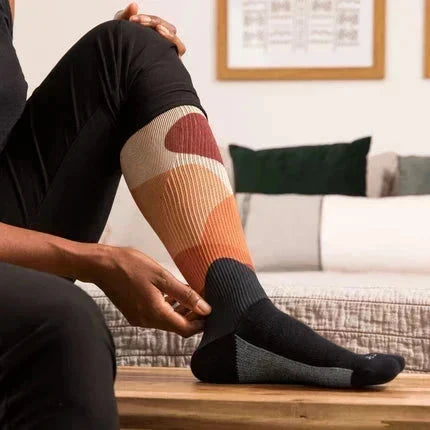
Compression socks are full-length socks, usually covering the whole foot and calf, that apply graduated pressure — tighter at the ankle, gradually looser going up the leg. That pressure pattern is designed to improve blood flow and reduce swelling, which is why you’ll see them recommended for:
- Long flights or long shifts on your feet
- Swelling in the lower legs and ankles
- General circulation support
- Reducing fatigue during and after exercise
The better ones go further than just compression, though — they also add targeted arch support, cushioning, and moisture-wicking materials, so you’re getting foot-specific support built into the same sock.
What Are Arch Sleeves?
Arch sleeves are much smaller — just a compression band that wraps around the middle of your foot, covering the arch only. No toes, no heel, no calf. They’re a targeted fix for one specific area, which makes them:
- Cheap and easy to slip on under any sock or shoe
- Good for a quick, localized boost of arch compression
- Not doing anything for your heel, Achilles, ankle, or calf
Think of an arch sleeve as a band-aid for one part of the problem, versus a sock that’s addressing the whole foot.
The Real Difference: Coverage
This is really the whole comparison. Arch sleeves only compress your arch. Compression socks — done well — support your arch, cushion your heel, protect your Achilles, and improve circulation up through your ankle and calf, all at once.
If your only issue is a very specific, mild ache right in the middle of your arch, a sleeve might feel like enough. But heel pain, plantar fasciitis, Achilles tightness, and all-day fatigue involve more than just your arch — which is exactly why a lot of people try an arch sleeve, feel some relief, but still deal with heel pain or tired calves at the end of the day.
Which One Should You Actually Get?
Get an arch sleeve if: you want something ultra-minimal, cheap, and localized, and your only complaint is very mild arch discomfort with no heel or calf symptoms.
Get compression socks if: you’re dealing with any of the following, since they cover more ground:
- Plantar fasciitis or heel pain (see these targeted exercises if that’s your main issue)
- Swelling or poor circulation, especially after standing all day
- Achilles tightness or calf fatigue
- General foot fatigue from work, training, or being on your feet for hours
If you’re already looking into natural ways to treat heel pain, compression socks are the “all-day support” half of that equation — stretching and icing do the active healing, and the socks carry that support through the rest of your day.
Frequently Asked Questions
Are arch sleeves as effective as compression socks?
For very mild, localized arch discomfort, they can feel like enough. For anything involving your heel, Achilles, or calf, they won’t do much since they simply don’t cover that area.
Can you wear an arch sleeve and a compression sock together?
Some people do, but it’s usually a sign the arch sleeve isn’t covering enough on its own — a full compression sock with built-in arch support does the same job without stacking two products.
Which is better for plantar fasciitis, a sleeve or a sock?
A full compression sock generally, since plantar fasciitis pain often comes with related heel and Achilles tightness that a sleeve doesn’t address. Here’s a closer look at the plantar fasciitis-specific evidence.
Do compression socks help with swelling better than arch sleeves?
Yes — graduated compression through the ankle and calf is what supports circulation and reduces swelling, and an arch sleeve doesn’t extend into that area at all.
So Why Not Just Get Both?
That’s actually a fair question, and it’s more or less how ArchTek came about. Dr. Bob Baravarian had spent decades treating patients who’d tape an arch sleeve under one sock and stack compression socks on top for the calf — layering products because nothing on the market covered the whole foot at once. So instead of a sleeve, he engineered the same targeted arch compression directly into a full sock, then added an Energy Return System for the fatigue a sleeve was never designed to touch, and cushioning around the Achilles for the part of the foot a sleeve doesn’t even reach.
The short version: an arch sleeve was always a workaround for a sock that didn’t exist yet. If plantar fasciitis specifically is what’s driving this decision for you, it’s worth seeing exactly how much compression helps before you buy either one.